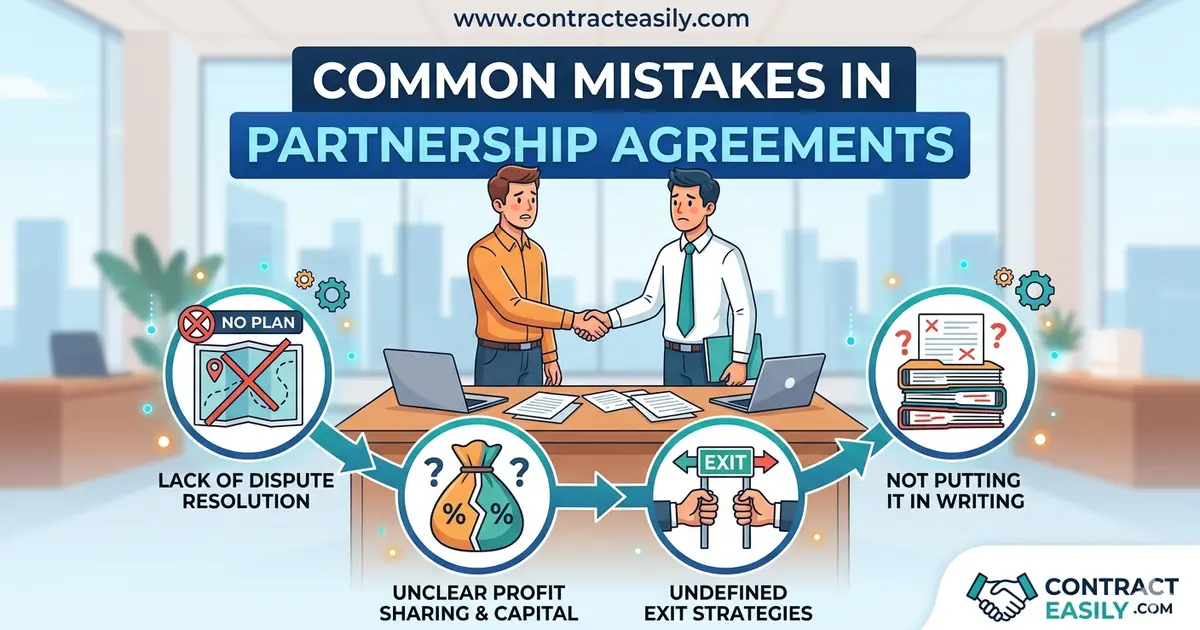
Starting a business with a partner can be exciting. Shared vision, combined skills, and pooled resources often make partnerships one of the most effective ways to build and grow a business. However, many partnerships fail not because the business idea is weak, but because the partnership agreement is poorly drafted or incomplete.
A well-drafted partnership agreement acts as the legal foundation of the business. It clearly defines rights, responsibilities, profit sharing, decision-making authority, and dispute resolution mechanisms.
Unfortunately, many founders either copy templates from the internet or proceed without formal documentation, leading to costly disputes later.
In this article, we discuss the most common mistakes in partnership agreements and how businesses can avoid them.
1. Not Having a Written Agreement
The biggest mistake is operating only on verbal understanding.
Many partners begin with trust and assume that mutual understanding is enough. While trust is important, business relationships evolve over time.
Without a written agreement, disputes over:
- Ownership percentage
- Investment contribution
- Profit distribution
- Roles and responsibilities
can quickly damage both the business and the relationship.
A written agreement provides legal clarity and prevents future misunderstandings.
2. Unclear Profit and Loss Sharing Terms
One of the most frequent disputes in partnerships relates to money.
Many agreements fail to clearly specify:
- How profits will be distributed
- Whether salaries or drawings are allowed
- Who bears operational losses
- Reinvestment rules
For example, one partner may expect equal profit sharing while another believes it should be based on capital contribution.
Your agreement should explicitly mention:
- Profit-sharing ratio and loss-sharing ratio (with clear percentages)
3. Undefined Roles and Responsibilities
Another common mistake is failing to define who does what.
For example:
- One partner handles operations
- Another handles finance
- Another manages sales
If responsibilities are not clearly assigned, accountability issues arise.
This often leads to situations where one partner feels overburdened while another is seen as not contributing enough.
The agreement should clearly define:
- Roles
- Authority
- Reporting structure
- Expected involvement
4. No Exit or Dissolution Clause
Businesses change.
A partner may wish to exit due to:
- Personal reasons
- Financial needs
- Strategic disagreements
- Relocation
Many agreements ignore this possibility.
This becomes a major legal issue when one partner wants to leave and the others do not agree on valuation or buyout terms.
A strong partnership agreement must include:
- Exit mechanism
- Notice period
- Valuation method
- Buyout rights
- Transfer restrictions
5. Ignoring Decision-Making Authority
Important business decisions often create friction.
Examples include:
- Taking loans
- Onboarding investors
- Signing major contracts
- Hiring senior employees
If decision-making powers are not defined, conflicts become inevitable.
The agreement should specify:
- Decisions requiring unanimous consent
- Decisions allowed by majority vote
- Daily operational authority
This avoids delays and internal disputes.
6. No Dispute Resolution Clause
Disagreements are natural in business.
The issue is not whether disputes will arise, but how they will be resolved.
A common mistake is failing to include a dispute resolution clause.
This should mention:
- Mediation
- Arbitration
- Jurisdiction of courts
- Governing law
Having this clause can save significant legal time and costs.
7. No Confidentiality or Non-Compete Terms
Partners often gain access to sensitive business information such as:
- Customer data
- Pricing models
- Vendor lists
- Intellectual property
- Trade secrets
Without confidentiality obligations, this information can be misused after exit.
A well-drafted agreement should include:
- Confidentiality clause
- Non-solicitation clause
- Non-compete restrictions (where legally enforceable)
8. Ignoring Capital Contribution Details
Many founders fail to clearly mention:
- Who invested what amount
- Whether contributions are in cash or assets
- Future capital obligations
This becomes problematic during expansion or funding rounds.
The agreement must record all capital contributions precisely.
Final Thoughts
A partnership agreement is not just a legal formality — it is a business protection document.
The most successful partnerships are built not only on trust but also on clear legal documentation.
By avoiding these common mistakes, businesses can prevent disputes, protect relationships, and focus on growth.
If you are starting a partnership or need to review an existing agreement, it is always advisable to get it professionally drafted and vetted.
Need Help Drafting a Partnership Agreement?
At Contract Easily, we help startups, SMEs, and founders draft legally sound partnership agreements tailored to their business structure.